THOUSANDS OF FREE BLOGGER TEMPLATES

Sabtu, 06 Juni 2009


Hell Girl (地獄少女 Jigoku Shōjo), also known as Jigoku Shoujo: Girl from Hell in Animax Asia's English-language television broadcasts,[citation needed] is an anime series, produced by Aniplex and Studio Deen. It premiered across Japan on numerous television stations, including Animax, Tokyo MX, MBS and others, between October 4, 2005 and April 4, 2006. Following the success of the first season, the series was followed soon after into a second, Jigoku Shōjo Futakomori (地獄少女 二籠 ), which premiered October 7, 2006 across Japan on Animax.[citation needed] A live-action television series adaptation started airing in Japan on Nippon Television from November 4, 2006.[citation needed] A third season of the anime, further continuing the series, was first announced on the mobile version of the series' official website Jigoku Tsūshin.[1] The official title of the third season was announced to be Jigoku Shōjo Mitsuganae (地獄少女 三鼎 ).[2] and began airing on Japanese TV October 4, 2008.[3]

PLOT


Most episodes are self-contained short stories in which the series narrates the suffering of a different individual caused by one or more antagonists. In general during each arc, the protagonists' dramas are explained in detail from the start of their grudges, through the escalation of their torment until it becomes unbearable and they resort to accessing the Hell Correspondence website. Although in general, the client gives the antagonist a chance, he or she usually ends up pulling the string on his or her doll and sending the antagonist to hell. Once they have pulled the string

, before taking the antagonist to hell, Ai Enma punishes the person for his or her sins with the help of her companions.

In the first season, the story soon follows a journalist named Shibata Hajime, a former blackmailer, and his daughter Tsugumi who shares a strange connection with the Jigoku Shōjo as they investigate the truth behind the Jigoku Shōjo. In the second season, a mysterious young girl from Hell, named Kikuri is introduced who is able to travel freely between Earth and the Twilight realm where Ai resides. Later, the plot centers around Takuma Kurebayashi, a boy who is blamed by his townsfolk for causing disappearances around the town that are in reality caused by the townsfolk using the Hell Correspondence. In the third season, some time after Ai's death, Kikuri returns along with a yokai named Yamawaro, who accepts an old offer from Ai to become her fourth assistant. The story follows Ai mysteriously revival from death and subsequent inhabitation of the body of a young schoolgirl, Yuzuki Mikage.

The Summary for ep.1

A round ball of light bounces through the city, as various events occur aro

und the Jigoku Tsushin. Ren sees a strange boy appear before him in a bathhouse, Kikuri reappears before Wanyudo, and Hone sees a vision of Ai when a butterfly lands in front of her in a bar. At a certain school later, three girls get into trouble with their teacher Tange when he finds out that they are passing notes. Having heard bad rumors about Tange, the girl named Itsuka later suggests that they need to take measures against him for their futures. Because of her father’s influence, the girl named Akie is given responsibility for dealing with most of this. As Kikuri returns to the Jigoku Tsushin with him in the meantime, the young boy from earlier is revealed to be named Yamawaro. He address Kikuri as “hime” while he assists with her childish desires. Mikage Yuzuki, one of the girls from earlier, sees a strange vision while in the bath that night. Ai appears out of the water, dragging her into it and sharing a kiss with her. Yuzuki puts this off as a dream afterwards, but unknown to her, a butterfly has wrapped around her back.

The next day, Akie re

veals that her father could not do anything because of the lack of proof against Tange. She doesn’t believe him to be a bad person either, so she leaves the other two girls without much thought. Itsuka still believes their situation is serious, however, so she convinces Yuzuki to accompany her in creating evidence against Tange. The two girls go to a love hotel that night, as Itsuka plans to take a picture of Tange when he passes. Yuzuki successfully shoots when Itsuka approaches who she believes is Tange, but this ironically turns out to be her father. With this, both of Itsuka’s parents appear in wonder of what she is doing in such a place. This brings Itsuka to the Jigoku Tsushin website that night, where she types in Tange’s name. Itsuka meets Ai as expected, who presents her with a doll that has a red string wrapped around it. She explains that by pulling the string, her enemy would be sent to hell. However, she would also follow after she died. Itsuka cannot believe these circumstances, but she reappears in her room with the doll before she can say any more. Yuzuki wakes from this vision, believing it to be another dream, but Ai appears to tell her that she is actually inside of her.

Itsuka continues to act rebellious at school the next day, even listening to her mp3 player in class. When Tange takes this from her, she runs out of the classroom in rage. While she looks through several places that afternoon in search for her mp3 player, T

ange appears to tell her that he has already cast it aside. Itsuka reveals what she has heard about Tange refusing to pass students that he does not like, guessing that he plans to do the same to her. Tange states that this is impossible, but Itsuka brings out her doll before he can suggest anything else. Yuzuki appears just in time to see Itsuka pull the string, then feeling pain as Ai bursts from her body. With this, the Jigoku Tsushin appear to torture Tange and bring him to hell. When Yuzuki reappears in her reality, she finds that Itsuka has a round mark below her neck. When Akie shows up as well, however, she reveals that Tange had given her Itsuka’s mp3 player to return. Further more, there are doodles in the notebook Tange always seemed to write bad notes into. In the end, Tange really wasn’t a bad person.

Hell Correspondence

The medium through which a client contacts Ai Enma has changed over the centuries. Initially clients would write the names of that whom they hated in a three-column newspaper advertisment. After which, clients could enter names into a BBS that was programmed in BASIC. When the internet became available, people access the a website known as the "Hell Correspondence" (地獄通信 Jigoku Tsūshin) or the "Hotline to Hell". Soon after, the site was adapted into a mobile version that could be accessed from cell phones.[4]

Each medium can only be used at midnight by one who harbors a desire for revenge against their object of hatred. Should someone submit the name of someone against whom they bear a grudge or immense hatred, the Ai Enma will take them to a realm of

perpetual twilight where she offers them a straw doll, one of her companions, with a red string wound around its neck and describe to the client the details of their contract; should the client pull the string the tied around the doll's neck, she will ferry the target of the revenge straightaway to Hell. However, once the client's life has ended, he or she will too go Hell; a black crest-shaped mark appears on the client's chest to serve as a permanent reminder of this and their decision to send someone to Hell.


You can Watch jigoku Shoujo Mitsuganae on AnimeCrazy.Net here's the Playlist of episode

http://www.animecrazy.net/category/more-running-anime/jigoku-shoujo-mitsuganae/

Rabu, 03 Juni 2009

Sejarah Blogger


Blogger adalah penulis catatan harian di internet atau halaman web. Blogger ini merupakan pengguna internet yang rajin mengisi weblog.
Salah satu kiprah blogger yang signifikan di tahun 2004 adalah keterlibatab mereka dalam kampanye calon presiden Amerika Serikat. Kubu John Kerry bahkan mendirikan weblog yang mencatat kegiatan kampanye sehari hari calon presiden dari Partai Demokrat itu. Dalam konvensi nasional kedua kubu, blogger juga mendapatkan porsi khusus. Undangan bagi para blogger untuk meliput gelaran tersebut sempat membuat iri jurnalis konvensional.

Adam L. Penenberg, kolumnis Wired, menyebut masa depan jurnalisme berada di tangan para Blogger. Ia menyebut sekarang adalah saatnya bagi blogger untuk mencari berita sendiri dan bukan hanya mengomentari berita yang ada. Hal itu terjadi dalam bencana gempa dan tsunami yang melanda Asia di penghujung 2004. Lusinan blogger di Srilanka, Thailand dan India memberikan laporan pandangan mereka terhadap bencana yang melanda.

sumber: kamus computer

Detroit Metal City ~LIVE ACTION~


An anime OVA series, twelve episodes of approximately 13 minutes each, was released on August 8, 2008. A live film adaptation directed by Toshio Lee appeared in Japanese theaters on August 23, 2008. The series takes its name from the KISS single "Detroit Rock City".Hey, heard a good news! Detroit Metal City, a famous new anime is available on Live action! still in the same story about the shy young man from village named Soichi Negishi that have a dream to be a famous pop singer,but, dreams don't pay the bill and finally he is trapped in a Death Metal Band named "Detroit Metal City" as the vocalist named Johannes Krauser II (nisei) under licensed of "death records Production" he can refuse to join DMC but he is too scared to refuse the manager of the band (ridicoulous reason, yeah, just for humour of film) And finally he is found his big-crush on college Yuri Aikawa, but, one more problem, Yuri HATES DMC's music SO MUCH because it contains much of rude words and disguisting action , Soichi must hide his alter-ego (other side) from Yuri.
Will Yuri love him? will Soichi go out from DMC? Check IT OUT!!!!

Characters

  • Soichi Negishi (根岸 崇一 Negishi Sōichi): The main protagonist. A calm and peaceful musician from Inukai, Ōita, he is a fan of Swedish pop who is the exact opposite of his alter-ego Johannes Krauser II (ヨハネ・クラウザーII世 Yohane Kurauzā Nisei), leader of the Death Metal band DMC (short for Detroit Metal City). Ashamed of his true job, Negishi must cope with DMC's rising fame while keeping it a secret from friends and family. Even though Negishi despises Krauser so much, he can never resist the temptation of invoking his demonic ego everytime he feels irritated. While performing as Krauser, Negishi proves to be a skilled guitarist, able to play just with his teeth.
In the OVA, Daisuke Kishio voices Negishi, while Yuji Ueda voices Krauser. Ken'ichi Matsuyama plays both parts in the live-action movie.
  • Yuri Aikawa (相川 由利 Aikawa Yuri): Negishi's friend from his college times and his main love interest. She loves Negishi's calm nature and songs, but dislikes DMC's music and its vocalist Krauser, unaware that they're the same person.
Played by Masami Nagasawa in the OVA, and by Rosa Kato in the live-action movie.
  • Terumichi Nishida (西田 照道 Nishida Terumichi): Curry-loving, overweight pervert of few words. An otaku; he is a fan of the ecchi anime "Cameltoe Squadron Bloomer" (くいこみ戦隊ブルマちゃん Kuikomi Sentai Buruma-chan). Nishida plays the part of Camus (カミュ Kamyu), DMC's drummer. Perhaps the most dedicated in the group; not even fire or venomous snakes will stop his drumming.
Played by Makoto Yasumura in the OVA, and by Ryuji Akiyama in the live-action movie.
  • Masayuki Wada (和田 真幸 Wada Masayuki): Plays the part of Alexander Jagi (アレキサンダー・ジャギ Arekisandā Jagi), DMC's bassist and a ladies' man from Saitama. He would like to leave DMC to perform in a visual kei/J-rock type band like X Japan, but just like the other members of the band, he fears their manager.
Played by Yuto Nakano in the OVA, and by Yoshihiko Hosoda in the live-action movie.
  • Death Records President (デスレコーズ社長 Desu Rekōzu Shachō): A foul-mouthed, sex-crazy blond woman in charge of DMC's career, who always comes with weird schemes to promote the band, most of them to Negishi's despair.
Played by Ai Kobayashi in the OVA, and by Yasuko Matsuyuki in the live-action movie.
  • Keisuke Nashimoto (梨元 圭介 Nashimoto Keisuke): A masochistic middle-aged man hired to perform during DMC's concerts as the "Capitalist Pig" (資本主義の豚 Shihonshugi no Buta), whose role is to let himself being beaten and abused by Krauser during the shows. He works part-time at a convenience store to make ends meet.
Played by Takashi Matsuyama in the OVA.
  • Jack ill Dark (ジャック・イル・ダーク Jakku iru Dāku): Also known as "The Emperor", he is a legendary Black Metal guitarist from the United States who chose to crush DMC during his farewell concert in Japan. But after unadvertedly bringing out Negishi's anger, he ended up being upstaged by Krauser, who became the legitimate heir to his legendary guitar and the title of "Emperor."
Played by Riki Takeuchi and Eugene Nomura in the OVA, and by Gene Simmons in
the live-action movie.

Anyway i have a link to a sweet song that Kenichi sing , "AMAI KOIBITO" Enjoy!! (Anyway kenichi looks so stupid with dora style hair cut)

http://www.youtube.com/watch?v=32kxnE-6yt4

Minggu, 03 Mei 2009

Death Note Facts


Controversy in China
posted on 2005-02-06 01:15 EST

Popular Manga Banned in Some Schools

Imitating events in the manga series Death Note, Chinese school students in the city of Shenyang have take to writing death notes. The students buy special stationary and follow instructions such as "Write the cause of death and the person's name backwards and the person will die in 40 seconds."

A middle school student told the Shenyang Night Report, "Many of my friends have Death Note. When they are tired of studying, they have fun by writing down the names of teachers they don't like."

Some Shenyang schools have banned the manga and related stationary, the newspaper called Death Note, "Poison, creating wicked hearts." Others however, including one major Chinese newspaper, feel that the ban is an over-reaction and is inappropriate. Some have suggested that overreactions such as these are what stifle creativity in China.


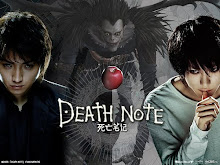
Kenichi Matsuyama an actor that play on three Death Note Live Action Series as L is dubbing for Jealous voice on 12th episode of death Note that titled "Love".


Shido Nakamura
Ryuk's seiyuu on DN live action and anime is a famous Kabuki actor on Japan, he ever play on Be With you , Letters From iwo jima and Fearless (with Jet Li)

Sabtu, 02 Mei 2009

Mello/ Death note in Wonderland


L Change The World


Yay, a spin-off of the Death Note movies starring the loveable and strange detective L (Kenichi Matsuyama)! Too bad the film's really not that good, though to be honest, diehard fans of Matsuyama's popular take on L will likely not care that much. L: Change the World is neither groundbreaking nor noteworthy, and exists mainly as fan service for the people who can't get enough of the slouching, sweets-loving bishonen detective who outwitted the dastardly Light Yagami (Tatsuya Fujiwara) in those Death Note movies. Rabid fans of the blockbuster manga adaptations will probably find this to be a suitable reward for their unabated fandom. However, the uninitiated may need to take a crash course in Death Note lore. It's either that, or wonder why everyone is so excited to see a movie about a modern rock refugee with bad posture.

One final case finds L when a series of connected events converge on his doorstep. L reestablishes contact with K, a member of Wammy's House, the prodigy-raising thinktank that gave birth to L, as well as numerous other letter-named geniuses (no word if James Bond's Q is a member of the ranks). Also, former colleague F dies after discovering a terrible virus in Thailand, but sends L an odd messenger: a young boy who's immune to the virus, and just so happens to be a whiz with numbers. Finally, 12 year-old Maki (Mayuko Fukuda) shows up on L's doorstep bearing another strain of the same virus. Her father Nikaido (Shingo Tsurumi) developed the virus, but some nefarious baddies want control of it. Their goal: to change the world. The bad guys want to provoke an outbreak of this new virus - which is described as a fun combination of the flu and Ebola - so that they can eliminate the majority of the human race, ridding the planet of useless people while also preserving the environment. Oh, they may also be able to make a few bucks on the side.

Changing the world? Ridding the planet of useless people? Those sound suspiciously like things that Light Yagami would do, though this connection between the original Death Note concept and the plot of L: Change the World is never truly explored. Unlike the previous films, L is an original screenplay (a novel adaptation was released roughly one month before the film premiere), carving its own fictional niche while making a few welcome, and satisfying nods to Death Note mythology. L is still incredibly quirky and smart, but without the original manga story as backup, the film suffers. L's charisma in the other films came not only from his quirky looks and behavior, but also from his ability to outthink and outwit everyone around him. In L: Change the World, L is presented as always ahead of the game, and there's never truly a moment where his intelligence impresses or entertains the audience. That's both a plus and a minus. The plus is it eliminates some of the heady and wordy exposition that weighed down the Death Note films. The negative is that it makes L: Change the World much less fun or surprising.

Not to worry, in place of L whipping his foes with his ultra-powerful brain, we get...character development! The original Death Note manga, anime, and movies were too concerned with Byzantine mindgames and convoluted plotting to deal with actual character development, so the change here is a novel one. This isn't the same "always solving crimes" L that we saw in the other films; this L has time to reflect upon his life and even his feelings, and the minor tweaks to the character are good ones. The filmmakers give L some emotional connection through his interaction with both Maki and the nameless little boy, and Kenichi Matsuyama makes the character's abundant strangeness watchable and endearing. For L fanboys (or fangirls, as is more likely) L: Change the World is enjoyable stuff, especially when you consider that the character will likely not make any more appearances except in prequels - which could still happen. Given the still-continuing fan love for all things Death Note, further adventures of L may already be in the works, pending the success or failure of this film.

( Near-L Change The World)

Kenichi Matsuyama, Youki Kudoh, Mayuko Fukuda, Kiyotaka Nanbara, Masanobu Takashima, Shingo Tsurumi , Megumi Sato, Shunji Fujimura, Sei Hiraizumi, Renji Ishibashi, Bokuzo Masana, Yuta Kanai, Asaka Seto, Eriko Toda, Tatsuya Fujiwara

Death Note 2 ~The Last Name~


When we last left Light Yagami (Tatsuya Fujiwara), he had just perpetrated the most elaborate and successful demonstration of his Death Note, the supernatural notebook that kills anyone whose name is written inside it. As a result of his clever scheming, Light was invited to join the investigation team chasing the mass murderer known as Kira - who just so happens to be Light, anonymously using the Death Note to kill scores of criminals daily. However, oddball super detective and avid sugar-lover L (Kenichi Matsuyama) truly suspects that Light is Kira, and he's not shy about letting Light know. During their initial and subsequent meetings, L basically rubs Light's face in his obvious suspicion.
However, instead of avoiding potential capture, Light embraces the chance to work side-by-side with his sweets-loving rival. Now that L and Light/Kira are working together, the stage is set for an epic battle between two insanely smart guys who like to talk a lot. It's a showdown of acrobatic mental geniuses, who use keen reasoning and elaborate mindgames to outwit their wily opponent. Who will be the last name written in the Death Note? Will it be the megalomaniacal Light, or the wacky but honorable L? And will Death Note fans pissed at the fate of the manga characters find this new cinema version to be satisfying?
The answer to that last question: yes and no. One portion of the Death Note fanbase won't be that happy because the fate of one character doesn't stray very far from his destiny as detailed in the manga. However, another portion of the fanbase should be tickled pink because the other character is served much better than his manga counterpart was. What does that mean to those not versed in Death Note lore? Probably nothing, though there's still some enjoyment along the way.
That is, if you can stay focused. Death Note is a very cerebral manga, and derives its thrills from mindgames, obtuse mental jousting, and layers of doublespeak that play much better on paper than on celluloid. Director Shusuke Kaneko doesn't do much to make the already wordy events of the manga more enthralling on film, and inserts plenty of wooden exposition to keep the audience tuned in - if they haven't fallen asleep. The first Death Note movie ended with the promise of L and Light's coming conflict, but because the sequel has to compress many volumes of manga into 141 minutes, much of the back-and-forth rivalry between L and Light gets excised in favor of talk, talk, and more talk. The uninitiated could get bored, and simply wonder why the two male leads wear so much eyeliner.
The unitiated might also be bothered by Erika Toda, who plays teenybopper popstar Misa Amane. Misa is egregiously perky and pouty, and the adorable Toda can be as annoying as she is charming. Misa enters the picture as the possessor of a second Death Note. Since she's a huge fan of Kira, she also uses the Death Note to punish criminals, and even becomes known as the "Second Kira". However, Misa is sloppy and not very smart - she's easily pinched by L, who figures that if Misa is the Second Kira, then her new boyfriend Light is the first one. It's smart thinking, but Light has his own elaborate plan built upon the Byzantine rules of the Death Note itself.
Light's plan involves handing the Death Note to a third party, Kiyomi Takada (Nana Katase), and getting her to do his dirty work for him. Kiyomi was also in the manga, but her film counterpart is actually an amalgamation of three separate characters. Still, her function is more or less the same as the manga. Basically, she's a pawn used by Light to prove his supreme smarts, and it works just as entertainingly on film as it did in the manga. Seeing Light's elaborate plans getting played out onscreen can be quite exciting, even though it basically invites whole pages of exposition to explain it all.
Not helping matters is the acting, which ranges from effective (Kenichi Matsuyama makes a lovable L) to labored (Tatsuya Fujiwara strains a bit as Light) to wooden or overdone (most of the supporting actors). Again, director Kaneko's handling is far from imaginative. Nearly everything that happens in Death Note: The Last Name also occurred in the manga (though perhaps in a less truncated form), and Kaneko translates it to the screen in a slavish and entirely too-routine manner. The film could have used more creativity or cinematic verve, but the most creative thing that the filmmakers probably did was persuade the Red Hot Chili Peppers to lend two of their songs to the soundtrack.
The film largely succeeds based on its built-in popularity, and those who read the manga will easily get the most out of the screen adaptation. Those who didn't read the manga will likely be more distracted by the film's obvious shortcomings (direction, pacing, acting), but there's still a major positive: Death Note's hook - a supernatural notebook that allows its bearer to play God - works in any medium, and makes for intriguing, and sometimes enthralling moral discussion. Is Light correct in using the Death Note to reshape the world in his own image? Is his brand of justice worth the necessary sacrifice of innocent lives? Or is he just a megalomaniacal murderer who's so in love with himself that he thinks the end justifies the means?